


AI tools for outpatient coding: a buyer's guide | CLAIRE
Discover AI tools built for outpatient coding. Compare platforms, features, and benefits to find the right solution for your practice.

Top AI assistants for medical coders in 2026 | CLAIRE
Compare the top AI assistants for medical coders in 2026. See features, accuracy rates, and integrations to find the right tool for your practice.

Can AI assist with inpatient medical coding? | CLAIRE
Discover how AI assists with inpatient medical coding by improving accuracy, reducing DNFB rates, and accelerating revenue capture with human oversight.

Best AI tools for medical coding compared | CLAIRE
Compare leading AI tools for medical coding. Discover features, accuracy rates, and pricing to find the right platform for your coding workflow.
How AI Helps With Outpatient Medical Coding
Outpatient coding is short notes at high volume, so speed and consistency decide the result. How AI reads a note and surfaces ICD-10-CM, CPT, HCPCS and E/M candidates, where autonomous coding fits and where it does not, the error patterns in the Nature benchmark, and how to start with a single high-volume specialty.

Can AI Help with Inpatient Coding? Complete Guide
Yes, with the principal diagnosis and the DRG still resting on human judgement. Where NLP earns its place on a long inpatient chart, what 68.1% top-1 and 90.0% top-5 on MIMIC-IV actually mean, CAC against autonomous coding side by side, and why the AHA pushes back on the claim that AI drives coding intensity.
Can AI Help Medical Coders Review Charts? 2026 Guide
Yes - but the evidence says augmentation, not replacement. A human-in-the-loop framework took senior coders from 0.72 to over 0.93 F1 and cut coding time 40%, while the best fine-tuned model alone reached 0.59 across a 7,942-code space and missed the rare half entirely. How NLP reads a chart, where the models break, and what to demand of a vendor beyond self-reported accuracy.

Best Medical Coding Software: Inpatient & Outpatient Guide
Inpatient and outpatient coding need different tools: ICD-10-PCS, MS-DRG grouping and CDI on one side, CPT, APC and E/M levelling at volume on the other. Ten platforms compared with their KLAS scores, plus the research showing revenue-targeted review beats random sampling more than two to one.

Best AI Tools for ICD-10-CM Coding in 2026
Four tiers of tool, one of them not worth buying: unvalidated LLM interfaces with no coding logic, audit trail or compliance controls. CLAIRE, Corti, CodaMetrix, Fathom, Nym, Solventum and Codify compared - with the published numbers (0.59 micro-F1 on MIMIC-IV, 31% for ChatGPT, a 0.43 gap between rare and common codes) and the seven things to demand before a contract.

Best AI Medical Coding Assistant 2026: Top Tools Compared
Four honest tiers, and a fourth that is dishonest: generic LLM wrappers sold as autonomous coding with no audit trail or code map. CLAIRE, CodaMetrix, Nym, Solventum and Medmio compared across coding model, explainability, audit trail and CDI support - plus why the best fine-tuned model still scores 0.59 F1 across the full code space, and the contract checks to run before a sandbox.

AI Tools to Find ICD-10 Codes from Clinical Notes
Yes, AI can read a note and suggest ICD-10 codes - but the benchmarks are sobering: GPT-4 agreed with a human coder on only 15.2% of full extractions, and 60% of its errors were codes for diagnoses the provider never confirmed. What NLP, fine-tuned transformers and RAG each contribute, how CLAIRE, Corti, AWS, Emedlogix and RCMCodex differ, and why human review is the part that cannot be removed.

AI Tools for Outpatient Coding: 2026 Top Solutions
Outpatient volume, E/M levelling and modifiers are what make this setting worth automating. CodaMetrix, Solventum, Fathom, Nym, MediCodio, Medmio and CLAIRE compared across autonomy, code sets and EHR fit - with the published benchmarks, the NCCI and MUE checks that are rules rather than model judgement, and why the research still calls these tools unsuitable as coder replacements.

AI Tools for Faster Inpatient Chart Coding
Inpatient charts push days-to-bill to 7-10 days, and most ambient AI is built for outpatient visits. A look at CLAIRE, Solventum, Nym, Fathom, LucasAI, Oracle Health and Evidently across DRG support, CDI queries and EHR fit - plus what the MIMIC-IV benchmarks really show about accuracy.

AI Medical Coding Tools: 2026 Top Picks & Guide
The vendor landscape sorted into three tiers - autonomous coding, AI-assisted workflows and code search - plus a fourth of wrapper tools with no audit trail or V28 support. What the accuracy numbers actually measure, where human review pays for itself, and the integration and compliance questions to ask before buying.
Affordable AI Medical Coding Tools for Remote Coders 2026
The market is split between enterprise contracts and a handful of tools a solo coder can actually buy. A side-by-side look at CLAIRE, Fathom, CureMD, Rivet, CodaMetrix and Nym across pricing model, code sets, integration and compliance - and why most published accuracy figures are self-reported rather than audited.

Is ChatGPT Accurate for Medical Coding? Findings
What the peer-reviewed benchmarks actually measured: 33.9% exact-match on ICD-10-CM and 49.8% on CPT in the Mount Sinai study, 14-22% in otology, fabricated codes across every model tested, and why laterality, modifiers and rare codes are where general-purpose LLMs break.

AI HCC Gaps in Clinical Documentation: 2026 Guide
How NLP and large language models surface conditions the record supports but the claim never carried: FHIR ingestion, extraction split from HCC mapping, V28 trumping logic, and why MEAT validation and the compliant query stay with the coder.
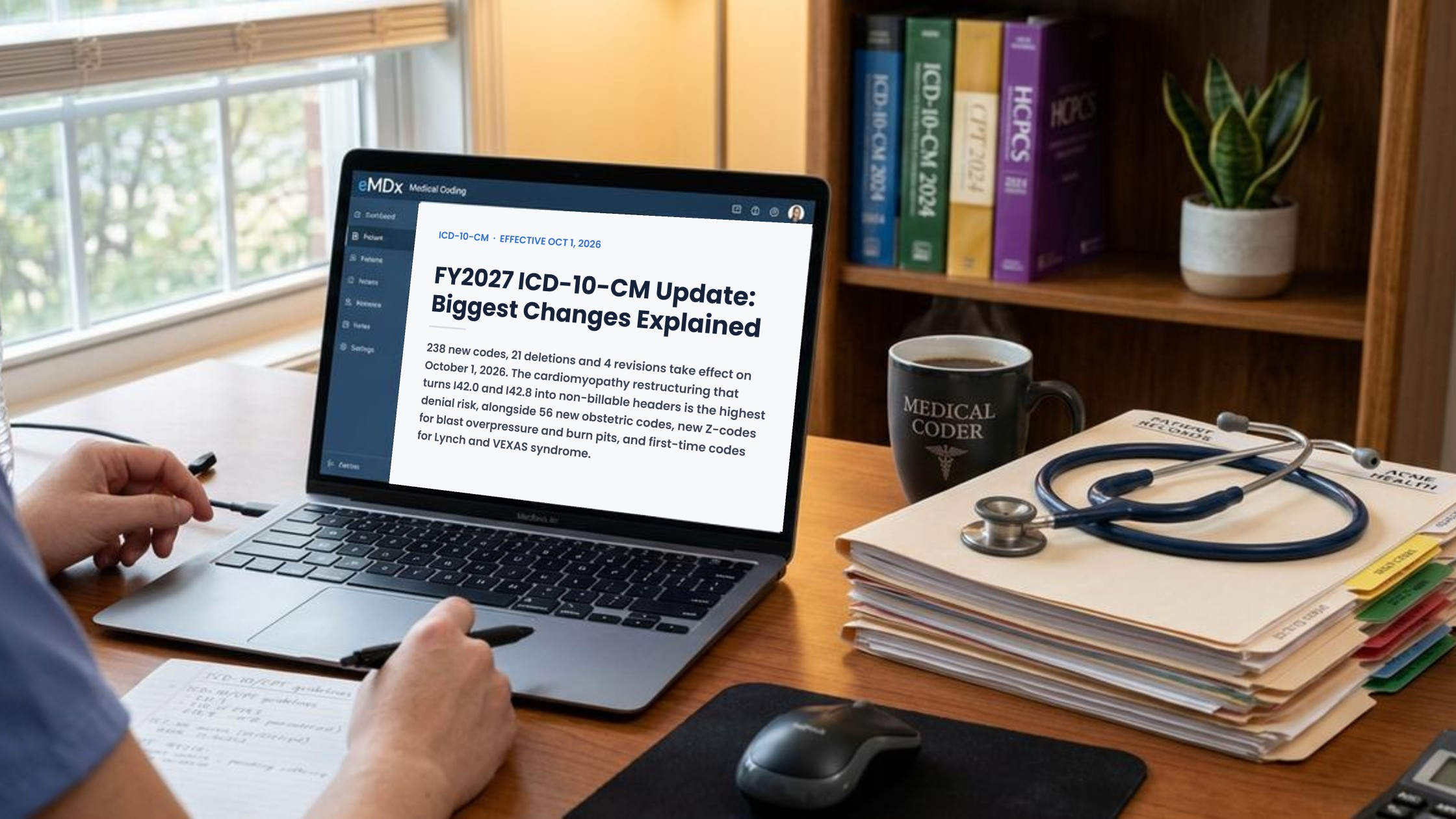
FY2027 ICD-10-CM Update: Biggest Changes Explained
238 new codes, 21 deletions and 4 revisions take effect on October 1, 2026. The cardiomyopathy restructuring that turns I42.0 and I42.8 into non-billable headers is the highest denial risk, alongside 56 new obstetric codes, new Z-codes for blast overpressure and burn pits, and first-time codes for Lynch and VEXAS syndrome.
Best CDI Software Tools for Hospitals: 2026 Comparison
A fair comparison of Iodine, Solventum, Nuance, SmarterDx, Ambience, Optum, Dolbey and CLAIRE across AI capability, EHR integration, pricing and KLAS scores, grounded in the ACDIS 2026 survey and the new AHIMA/ACDIS query practice guidelines.
Best AI Tools for Inpatient Medical Coding 2026
Inpatient coding resists automation in ways outpatient does not. A look at CodaMetrix, Nym Health, 3M 360 Encompass and CLAIRE across MS-DRG accuracy, CDI integration and compliance, and why 55-70% of encounters still reach a human coder.
Best AI Medical Coding Tool 2026: Comparison Guide
No single platform is universally best. A side-by-side look at CLAIRE, Fathom, CodaMetrix, Nym Health and RapidClaims across autonomy, EHR integration, compliance and ROI, and where vendor accuracy claims diverge from independent testing.
Best AI Medical Coding Assistants for Coders 2026
Autonomous coding or AI-assisted augmentation? A comparison of CodaMetrix, Nym, Fathom, Solventum, RapidClaims, Optum and CLAIRE, and why vendor accuracy numbers deserve scrutiny.
Claire AI for POA Indicator Accuracy: Preventing Hospital-Acquired Condition Reporting Errors
Claire AI improves POA indicator accuracy by analyzing the clinical timeline for each diagnosis, flagging HAC-program conditions, and preventing the over- and under-reporting errors that drive unfair quality penalties.
How Claire AI Improves Principal Diagnosis Selection for Inpatient Coders
Claire AI improves principal diagnosis selection by analyzing the clinical timeline against UHDDS criteria, resolving ambiguous documentation, and generating compliant queries—ensuring accurate, consistent DRG-driving decisions.
Claire AI for Surgical Procedure Coding: Mastering ICD-10-PCS with Clinical Reasoning
Claire AI brings clinical reasoning to ICD-10-PCS surgical coding—determining root operations, validating device coding, and constructing accurate seven-character codes to prevent DRG errors and audit risk.
Claire AI vs Manual Coding: A Cost-Benefit Analysis for Hospital Leaders
A full cost-benefit analysis of Claire AI vs manual coding: 15-30% productivity gains, 20-40% fewer denials, audit prevention, and no implementation cost—delivering positive ROI within the first month.
Claire AI for HCC Coding and Risk Adjustment: Capturing Accurate RAF Scores
Claire AI helps risk adjustment teams capture accurate RAF scores—identifying all qualifying HCC conditions, validating documentation specificity for RADV audits, and generating compliant queries while avoiding overcoding.
How Claire AI Reduces Inpatient Coding Audit Risk and Improves Compliance
Claire AI reduces inpatient coding audit risk with comprehensive pre-submission validation—catching missed diagnoses, POA errors, and unsupported severity coding before claims are submitted, while building audit-defense documentation and a proactive compliance culture.
How Claire AI Powers Clinical Documentation Integrity Programs for Better Outcomes
Claire AI strengthens CDI programs with clinical reasoning, automated documentation analysis, compliant query generation, and real-time severity impact visibility—cutting review time 60-70% and lifting query response rates 20-30%.
Claire AI and Sepsis Coding: Clinical Reasoning for Complex Diagnoses
Claire AI brings structured clinical reasoning to sepsis coding—analyzing documentation against Sepsis-3 criteria, identifying organ dysfunction, and generating compliant queries to distinguish sepsis, severe sepsis, and septic shock.
Claire AI for New Coder Onboarding: Accelerating Time to Productivity
Claire AI accelerates new coder onboarding with structured clinical education, real-time guidance, and automated quality validation—reaching full productivity 30-50% faster while cutting supervisor training hours 50-70%.
How Claire AI Boosts Inpatient Coder Productivity by 15-30%
Claire AI lifts inpatient coder productivity 15-30% by eliminating time-consuming work—automating documentation review, accelerating code selection, cutting supervisor escalation 40-60%, and preventing rework through quality validation.
Claire AI vs Traditional Computer-Assisted Coding: What Is the Difference?
Claire AI differs from traditional CAC systems in three ways: clinical reasoning over keyword matching, collaboration over replacement, and educational explanations that build coder knowledge. A full comparison vs CAC, autonomous, and manual coding.
How Claire AI Helps Inpatient Coders Write Better CDI Queries Faster
Claire AI helps inpatient coders write compliant, physician-friendly CDI queries faster—identifying documentation gaps, generating ACDIS/AHIMA-compliant language, and improving physician response rates 20-30%.
What Is Claire AI? The Complete Guide to AI-Powered Medical Coding Assistance
Claire AI is a collaborative coding assistant that augments inpatient coders with documentation analysis, clinical reasoning, code suggestions, and compliant query generation—delivering 15-30% productivity gains with no EMR integration required.
How to Read Medical Documentation Like a Senior Coder: Developing Clinical Pattern Recognition
A skill-building guide for inpatient coders to develop the clinical reasoning, pattern recognition, and documentation analysis techniques that distinguish expert coding professionals.
Revision vs Replacement Joint Procedures: Critical ICD-10-PCS Coding Differences for Inpatient Coders
A detailed guide to distinguishing joint revision from replacement procedures with root operation selection, device value assignment, and clinical scenario analysis.
Understanding SOI and ROM: How Complication and Comorbidity Coding Impacts Hospital Quality Metrics
Severity of illness and risk of mortality scores are the invisible architecture behind hospital quality measurement. How CC and MCC coding drives SOI and ROM, and how to capture the conditions that are commonly missed.
The Future of the Medical Coding Workforce in the AI Era
AI will not eliminate coding jobs but fundamentally transform them. Human coders shift to quality oversight, exception management, CDI, and complex case resolution as the workforce evolves toward higher-skill roles.
How to Resolve Complex Medical Coding Cases Without Supervisor Escalation
A practical framework for independent problem-solving of challenging inpatient coding scenarios using clinical reasoning, official guidance, and AI-assisted research.
Remote Medical Coding with AI Assistance: Best Practices for Productivity and Accuracy
A practical guide for remote inpatient coders using AI-powered coding assistants to overcome isolation challenges, maintain quality, and achieve productivity goals from home.
Calculating ROI on AI Medical Coding Investments: A Financial Guide for Healthcare Leaders
Healthcare organizations typically reach positive ROI on AI coding within 6-12 months, with three-year returns of 200-400%. A financial framework covering TCO, value drivers, and realistic timelines.
Autonomous Medical Coding: How Close Are We in 2026?
Autonomous coding is already live for radiology, pathology, and routine visits at 97-99% accuracy. Complex cases still need human review. Industry consensus: 40-50% of encounters fully autonomous by 2027, 70-80% by 2029.

AI's Role in Modern Revenue Cycle Management: Beyond Coding
AI transforms revenue cycle management far beyond coding: prior authorization automation, charge capture optimization, denial prediction, intelligent payment posting, and predictive cash flow analytics. Organizations report 15-25% lower days in AR and 30-40% fewer denials.
Emergency Department Coding with AI: Achieving Speed and Accuracy Under Pressure
ED coding operates under unique speed and documentation constraints. AI assigns E&M levels, procedure codes, and diagnoses in real-time at 93-96% accuracy, cutting turnaround from 3-7 days to same-day and reducing denials 20-30%.
How AI Improves Inpatient Medical Coding and DRG Assignment Accuracy
Inpatient coding drives hospital reimbursement through DRG assignment. AI captures principal diagnosis, secondary diagnoses, and CC/MCCs to deliver 15-25% CMI improvement, 30-40% fewer DRG mismatches, and 95-97% accuracy.
AI Solutions for Outpatient Medical Coding: Challenges and Opportunities
Outpatient coding is the highest-volume environment in healthcare. AI hits 94-97% accuracy on E&M selection, procedure coding, and modifiers, cutting turnaround from days to hours and lifting accuracy 20-35%.
AI in Specialty Medical Coding: Cardiology, Orthopedics, Oncology, and Beyond
Specialty coding demands deep clinical knowledge. AI models trained on specialty-specific data hit 93-98% accuracy across cardiology, orthopedics, oncology, and radiology, beating general coding AI by 15-25%.
Ensuring Regulatory Compliance with AI Medical Coding Tools: A 2026 Guide
AI coding enhances compliance through consistent guideline application, audit trails, and proactive risk flagging, but requires governance, human oversight, and validation to meet CMS, OIG, and payer requirements.
Reducing Claim Denials Through AI-Powered Medical Coding Accuracy
Coding issues cause 40-60% of claim denials. AI-powered pre-submission validation cuts denial rates 40-50% by catching errors, missing documentation, and authorization gaps before claims reach payers.
Integrating AI Medical Coding with Electronic Health Records: The Complete Technical Guide
AI coding integrates with EHRs through HL7 FHIR APIs, native vendor APIs, or middleware. Deep integration takes 3-9 months and delivers 40-60% efficiency and 25-35% accuracy gains over standalone systems.
AI-Powered Medical Coding Audits: A Comprehensive Guide for 2026
AI-powered coding audits review 100% of encounters in real-time, catch 85-95% of errors before submission, and reduce error rates 40-60% — moving audit teams from random sampling to targeted investigation.
How AI Enhances Clinical Documentation Integrity Programs in 2026
AI enhances clinical documentation integrity by reviewing notes in real-time, identifying gaps before coding, prioritizing cases, and predicting documentation deficiencies — improving query response rates 35-50%.
Medical Coding Accuracy: Proven Strategies to Achieve 95%+ in Your Organization
Achieving 95%+ medical coding accuracy requires a comprehensive approach combining guideline knowledge, quality assurance, continuous education, and technology support — including AI tools that reduce error rates by 30–50%.
The Future of Medical Coding: Trends and Predictions for 2026-2030
The future of medical coding centers on deeper human-AI collaboration, with the AI medical coding market projected to grow from $2.99 billion in 2025 to over $10 billion by 2035. Key trends include autonomous coding for routine cases, predictive analytics for documentation improvement, point-of-care coding guidance, and specialized AI for complex specialties. Human coders will focus on complex cases, quality assurance, and clinical judgment while AI handles routine processing with increasing sophistication.
Medical Coding AI Agent vs. Medical Coding Assistant: Understanding the Difference
A medical coding AI agent acts autonomously to process and code charts with minimal human intervention, typically handling routine cases independently. A medical coding AI assistant supports human coders by providing recommendations, explanations, and guidance while the coder remains the final decision-maker. Research shows that AI assistant models achieving human-AI collaboration deliver 0.93 F1 accuracy, outperforming both fully autonomous agents (0.80-0.84) and human-only coding (0.72). For healthcare organizations, the assistant model provides better accuracy, compliance safety, and coder development.
AI Clinical Coders: How Artificial Intelligence Is Transforming Healthcare Documentation
AI clinical coders use natural language processing and machine learning to analyze clinical documentation and support coding professionals with intelligent recommendations.
Medical Coding Compliance in the AI Era: Navigating Regulations and Risk
Medical coding compliance in the AI era requires maintaining human accountability while leveraging artificial intelligence for accuracy improvements.
The ROI of Medical Coding AI Tools: Calculating Real Returns for Healthcare Organizations
Healthcare organizations implementing medical coding AI tools typically achieve ROI within 6-12 months through reduced claim denials, productivity gains, and captured revenue from improved coding specificity.
How to Evaluate Medical Coding AI Platforms: A Comprehensive Checklist
A comprehensive, vendor-ready checklist to evaluate AI coding platforms: explainability, accuracy, workflow fit, guideline updates, oversight, security, costs, and pilot design.
Will Medical Coding Be Replaced by AI?
Will AI replace medical coders? The data says no — learn what employment trends, salaries, and real-world adoption show about the future of coding.
Medical Coding AI Assistant: What to Look For in 2026
When selecting a medical coding AI assistant, prioritize explainability, clinical accuracy, workflow integration, and human control.
Common Medical Coding Mistakes That Cause CPC Exam Failure
The CPC exam is one of healthcare’s toughest certification tests. Learn the mistakes that cause most failures—and proven strategies to pass.
How AI Medical Coding Tools Improve Accuracy Through Explainable Clinical Reasoning
Medical coding accuracy directly impacts healthcare reimbursement, compliance, and data quality.
ICD-10-CM Codes: How to Master Them Faster
The International Classification of Diseases, Tenth Revision, Clinical Modification (ICD-10-CM) contains over 68,000 diagnosis codes spanning 21 chapters.
How AI Medical Coding Tools Improve Documentation Clarity
Clinical documentation serves as the foundation of medical coding. Every code assigned depends on what physicians document in the medical record.
AI Medical Coders vs. Human Coders: Why Collaboration Wins
Why AI medical coders and human coders achieve better results together, backed by research on accuracy, efficiency, and real-world outcomes.
What Is a Medical Coding AI Assistant? A Practical Guide for Remote Coders
A practical guide to medical coding AI assistants for remote coders and certification students, how they work, key capabilities, and what to look for.
Medical Coding AI Tools: How AI Supports Modern Medical Coders
A practical guide to AI medical coding tools: explainability, workflow fit, and how AI augments coders, not replaces them.