



The CLAIRE Blog
Can AI assist with inpatient medical coding? | CLAIRE
Discover how AI assists with inpatient medical coding by improving accuracy, reducing DNFB rates, and accelerating revenue capture with human oversight.
Courtney HoatsonRHIA, CDIP, CCS, CRC, LSSGB
Table of Contents
- Why inpatient medical coding is uniquely complex
- How AI reads and interprets inpatient clinical documentation
- Measurable benefits of AI for inpatient coding teams
- Where AI falls short and why human oversight stays necessary
- AI-powered tools transforming inpatient coding workflows
- Compliance, auditability, and regulatory guardrails
- Frequently asked questions
- Takeaways
- See how CLAIRE supports inpatient coding teams
Can artificial intelligence assist with inpatient medical coding? Yes. AI-powered tools now help coding teams interpret complex clinical documentation, suggest ICD-10-CM and ICD-10-PCS codes, and support DRG assignment with human oversight. Peer-reviewed research from 2025 and 2026 documents measurable productivity gains. That research also makes clear that AI works best as an assistant to expert coders, not a replacement for them.
Why inpatient medical coding is uniquely complex
Inpatient coding hinges on MS-DRG assignment, which determines hospital reimbursement based on the principal diagnosis, secondary diagnoses, and complications and comorbidities (CC/MCC). Selecting the wrong principal diagnosis can shift the entire DRG and cost a hospital thousands of dollars per case.
Unlike outpatient encounters, inpatient cases require coders to review extensive clinical documentation: physician notes, discharge summaries, lab results, operative reports, and treatment records. A single admission can generate dozens of pages that the coder must synthesize to identify the correct codes.
ICD-10-PCS procedure codes add another layer with their 7-character alphanumeric structure. Each character represents a specific detail about the procedure, from the body system to the approach to the device used. Getting one character wrong changes the entire code.
The volume and complexity create real bottlenecks: long documentation review times, high coder workload, and a higher risk of coding errors.
How AI reads and interprets inpatient clinical documentation
Natural Language Processing (NLP) enables AI to extract relevant clinical information from unstructured EHR documentation. Physician notes, discharge summaries, and progress notes, typically written in narrative form, get parsed into structured data the system can analyze.
Large Language Models (LLMs) go further by interpreting clinical context. They identify relationships between documented conditions, treatments, and outcomes to suggest ICD-10-CM diagnosis codes and ICD-10-PCS procedure codes based on the evidence in the documentation.
Research on AI accuracy for DRG assignment is still emerging. A 2025 study by Yeli Feng, published in BMC Medical Informatics and Decision Making, used GPT-4o on the MIMIC-IV dataset. It achieved 68.1% top-1 accuracy and 90.0% top-5 accuracy for MS-DRG assignment across the 30 most frequent MS-DRG codes. Mount Sinai's 2025 NEJM AI study showed that a retrieval-augmented 'lookup-before-coding' method improved AI accuracy across nine models tested on 500 ED visits.
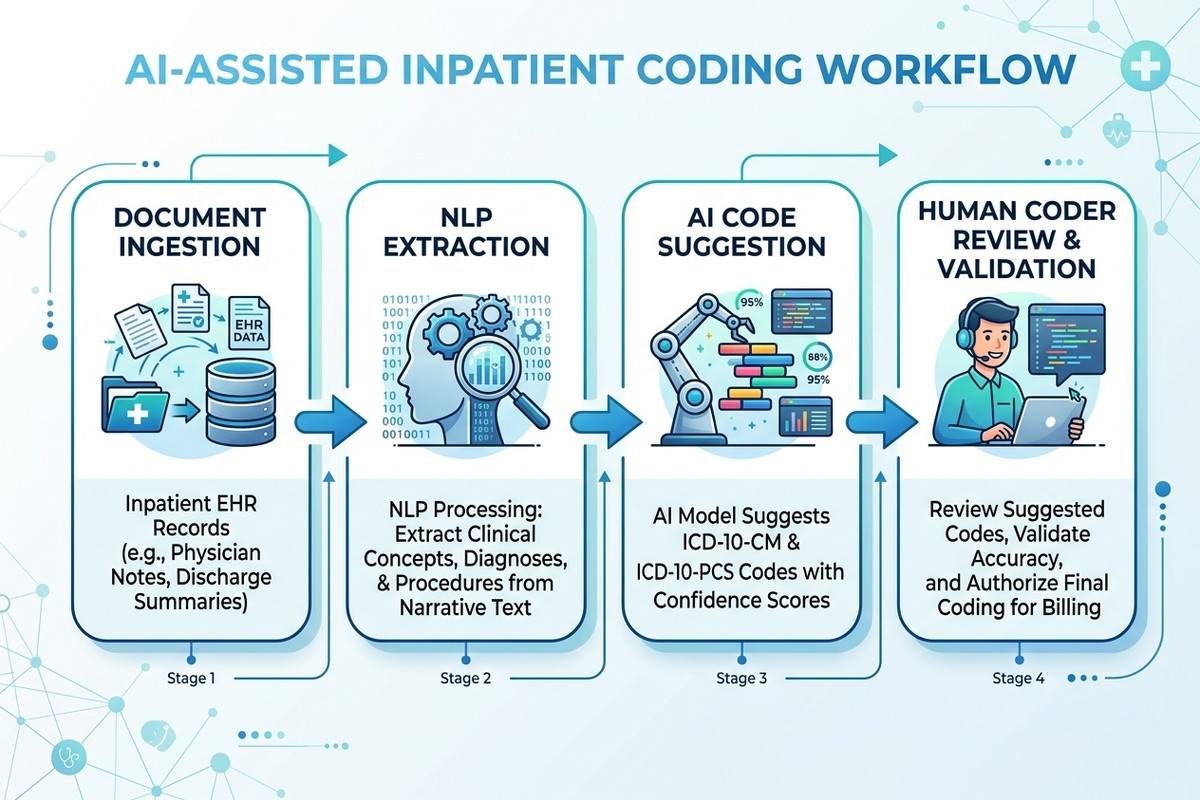
A typical AI workflow moves through four stages: document ingestion, NLP extraction of clinical concepts, code suggestion with confidence scoring, and human review. For a practical walkthrough, see this guide to AI-powered medical coding assistance. The coder remains the final decision-maker at every step.
Measurable benefits of AI for inpatient coding teams
The most rigorous evidence comes from a 13-week randomized controlled trial published in npj Digital Medicine in 2026. Ten certified coding specialists coded 10,688 summaries using three AI-assisted workflows. All three were significantly faster than manual coding (p<0.001), with PubMedGPT-2 producing the largest average time reduction. Coder uptake of AI-assisted workflows rose from 37.26% in October to 90.59% in December 2024.
A companion SAGE study found that GPT-2 reduced average coding time per record by approximately 75 seconds. For a coder handling 30 records per day, that translates to 37.5 minutes saved daily. A Scandinavia crossover RCT published in JMIR found a 46% reduction in median coding time on longer clinical texts (mean 307 words). Shorter notes showed no significant time benefit.
| Group | Median coding time per record (seconds) |
|---|---|
| Manual coding | 267 s |
| AI-assisted coding | 144 s |
Source: Chomutare et al., Journal of Medical Internet Research, 2025.
Faster coding can reduce Discharged Not Final Billed (DNFB) accounts by accelerating code assignment and claims processing. Fewer rework cycles also lower coding operations costs. Improved coding accuracy supports appropriate Case Mix Index (CMI) reflection and can reduce claim denials.
Hospital adoption reflects these gains. In 2024, 71% of US hospitals reported using predictive AI integrated with their EHR, up from 66% in 2023. Billing automation was the fastest-growing use case, jumping 25 percentage points from 36% to 61%, according to ONC/HHS data. The AI in medical coding market reached $2.74 billion in 2024 and is projected to grow to $5.27 billion by 2029 at a 14.0% CAGR.
Where AI falls short and why human oversight stays necessary
A 2026 Frontiers in Medicine article states that LLMs are 'more appropriately positioned as coding assistance tools rather than systems capable of independently completing medical coding.'
Hallucinations and prompt sensitivity remain real challenges. AI can generate incorrect coding suggestions or false quality alerts, especially when documentation is ambiguous. Rare diagnoses with smaller training samples produce lower accuracy rates. A study of 230,645 inpatient admissions found that a domain-specific language model achieved a micro-averaged F1 score of 0.7821.
Long inpatient clinical documents pose processing difficulties for AI models, but they are also where AI adds the most value. The Scandinavia trial confirmed this pattern: time savings appeared on longer texts, not on shorter notes.
Upcoding is another concern. AI tools may assign secondary diagnoses without sufficient evidence of treatment, potentially inflating reimbursement. BCBSA analysis estimated $663 million in inpatient spending may be tied to AI-powered coding tools, with concerns about this exact issue. The human-in-the-loop model addresses this by requiring expert coders to validate every AI suggestion, especially for ambiguous or complex cases.
AI shifts the coder's role from manual data extraction to validation, complex case review, and physician education. This is a higher-value use of expert coders' time, but it depends on keeping humans in the loop.
AI-powered tools transforming inpatient coding workflows
Computer-Assisted Coding (CAC) systems are the earlier generation of NLP-based coding tools. They identify keywords and suggest matching codes but lack the contextual understanding that newer LLM-based tools provide. The shift from traditional CAC to AI assistants reflects this difference in reasoning capability.
Autonomous coding platforms aim to assign and finalize codes without human intervention. Per KLAS Research's 2025 report, adoption is most prevalent in radiology and emergency departments, specialties with high volume and less variability. Inpatient coding is the next frontier due to its greater complexity. Nym customers specifically want the platform to support inpatient care specialties, an indication that area is not yet mature.
CDI optimizers use AI to identify documentation gaps and generate physician queries for clarification. These tools help coders and CDI specialists catch missing or ambiguous documentation before codes are assigned.
Built by coders for coders, this approach interprets clinical documentation and suggests ICD-10-CM, CPT, and HCPCS codes with explanations of clinical reasoning. Instead of just returning a code, it shows the coding pathway so the coder can validate the decision with confidence.
The KLAS report names additional vendors, including Fathom and CodaMetrix, but none has achieved mature autonomous coding for inpatient settings. For inpatient teams, the relevant choice is between two models. Autonomous platforms aim to code without human review. AI assistants suggest codes for a coder to validate.
Compliance, auditability, and regulatory guardrails
AI solutions must adhere to official coding guidelines, including ICD-10-CM/PCS rules and DRG assignment requirements set by AHIMA and AAPC. Transparent AI models with explainable reasoning help coders understand why a specific code was suggested, which supports both trust and compliance.
Audit trails track every AI-assisted coding decision for retrospective review. If a claim is questioned, the organization can trace which documentation the AI used and how the coder validated the suggestion. HIPAA-aligned safeguards and appropriate security controls help protect protected health information when AI processes it, subject to how the system is implemented and governed.
Hospital governance is catching up. In 2024, 82% of US hospitals evaluated predictive AI models for accuracy and 74% evaluated for bias, per ONC/HHS data. Governance frameworks should define when AI suggestions require mandatory human review versus when they can be auto-accepted. Full autonomy has not been demonstrated for inpatient coding.
Frequently asked questions
Can AI fully replace human medical coders for inpatient cases?
No. AI generates suggestions, but the coder remains accountable for accuracy and compliance. Expert coders validate outputs, resolve ambiguous cases, and apply official coding guidelines. The current evidence base, including the Frontiers in Medicine article cited above, treats AI as an assistive tool rather than an autonomous coder.
How accurate is AI when assigning inpatient DRG codes?
Accuracy varies by study design. Top-1 accuracy means the model's first choice is correct; top-5 means the correct answer appears among the top five suggestions; F1 score balances precision and recall. The GPT-4o study cited above achieved 68.1% top-1 and 90.0% top-5 accuracy for MS-DRG assignment. A domain-specific model trained on 230,645 inpatient admissions reached a micro-averaged F1 score of 0.7821. Vendor figures like Fathom's 90% claim use different methodologies and lack independent validation.
Does AI actually speed up inpatient medical coding?
Yes. AI-assisted workflows are significantly faster than manual coding while maintaining accuracy. The largest gains appear on longer, more complex inpatient records.
What are the main risks of using AI for inpatient coding?
Risks include upcoding, where AI may assign secondary diagnoses without sufficient clinical evidence, potentially inflating reimbursement. Other risks include hallucinations, difficulty with rare diagnoses, privacy concerns, and the need for audit trails. The human-in-the-loop model mitigates these risks by requiring expert coders to validate AI suggestions before codes are finalized.
How does AI handle long inpatient clinical documents?
Long documents are where AI shows the most benefit. Mount Sinai's retrieval-augmented approach improved accuracy by giving models access to coding references before assignment, though this method is still in pilot testing.
Takeaways
- AI reduces inpatient coding time, with the largest gains on longer, documentation-heavy records
- Human oversight remains essential; AI is an assistive tool, not a replacement for expert coders
- Hospital adoption is growing, with billing automation as a leading use case
- Autonomous coding is mature in radiology and EDs but not yet in inpatient settings
- Compliance requires audit trails, explainable reasoning, and governance frameworks for human review
See how CLAIRE supports inpatient coding teams
AI-powered code suggestions come with clinical reasoning explanations so coders can validate decisions with confidence. The platform integrates ICD-10-CM, CPT, HCPCS, and ICD-10-PCS code search into a single workflow, which can reduce the need to switch between separate coding-reference tools. Instant expert-level clarification reduces delays from traditional peer consultations, and compliant CDI query generation helps coders create clinically supported queries that physicians can quickly respond to.
If your inpatient coding team is evaluating AI tools, we can show you how the platform fits into your existing revenue cycle management workflow. Schedule a demo to see it in action and learn how it can reduce your DNFB accounts while maintaining coding accuracy.
Related Posts
Best AI tools for medical coding compared | CLAIRE
Compare leading AI tools for medical coding. Discover features, accuracy rates, and pricing to find the right platform for your coding workflow.
Read moreHow Claire AI Helps Inpatient Coders Write Better CDI Queries Faster
Claire AI helps inpatient coders write compliant, physician-friendly CDI queries faster—identifying documentation gaps, generating ACDIS/AHIMA-compliant language, and improving physician response rates 20-30%.
Read moreReducing Claim Denials Through AI-Powered Medical Coding Accuracy
Coding issues cause 40-60% of claim denials. AI-powered pre-submission validation cuts denial rates 40-50% by catching errors, missing documentation, and authorization gaps before claims reach payers.
Read more
Experience Clinical Clarity Today
Join medical coding professionals who trust CLAIRE for accurate, explained guidance. Start your free trial - no credit card required. No EMR integration needed.

The AI Medical Coding Assistant,
Built for Real-World Clinical Workflows
© 2026 CLAIRE IT AI. All rights reserved.