



The CLAIRE Blog
FY2027 ICD-10-CM Update: Biggest Changes Explained
238 new codes, 21 deletions and 4 revisions take effect on October 1, 2026. The cardiomyopathy restructuring that turns I42.0 and I42.8 into non-billable headers is the highest denial risk, alongside 56 new obstetric codes, new Z-codes for blast overpressure and burn pits, and first-time codes for Lynch and VEXAS syndrome.
Valentina GallegosBA, CPC, CRC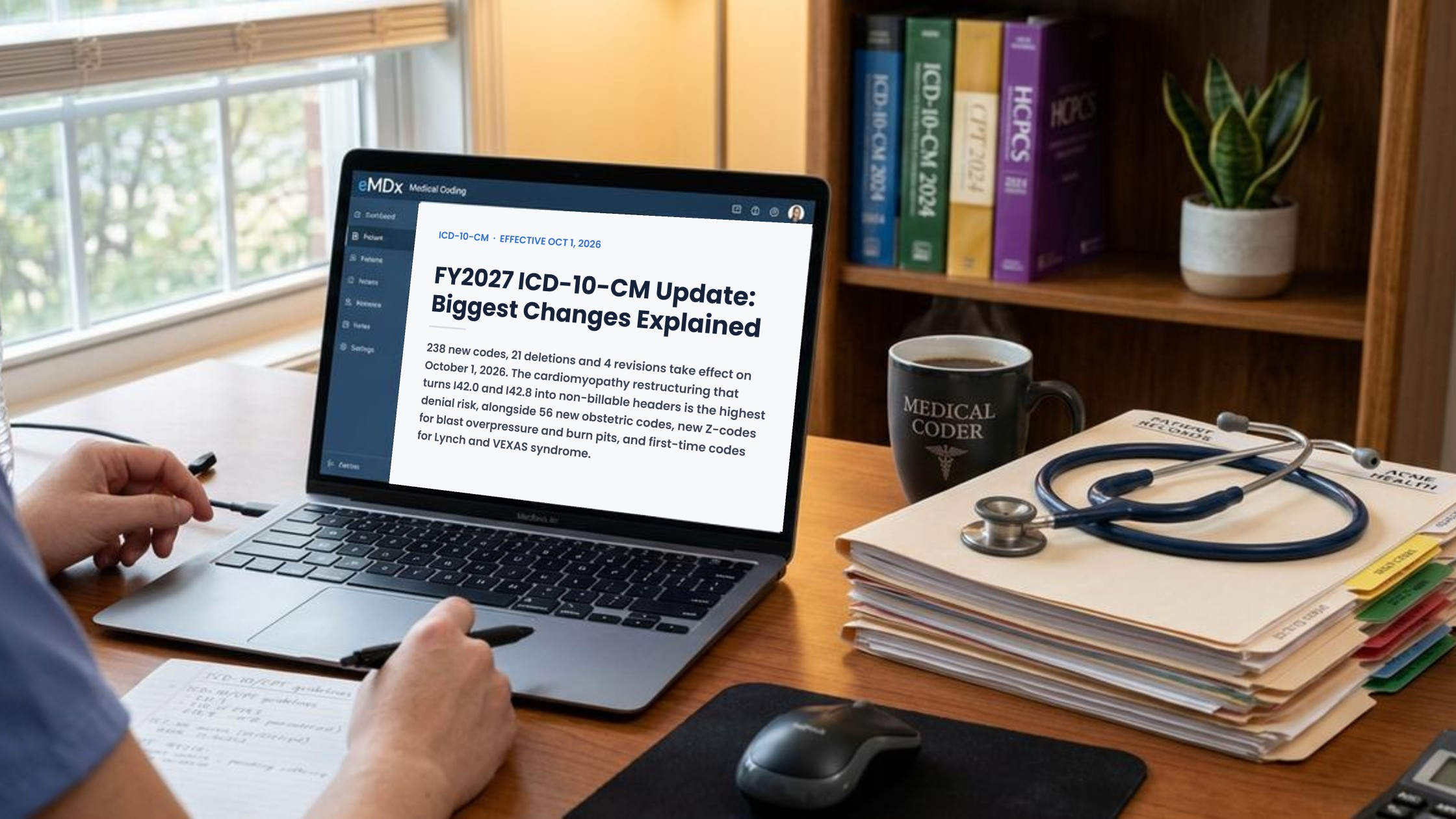
Table of Contents
- Executive Summary: Key Changes in the FY2027 ICD-10-CM Update
- Effective Dates and Implementation Timeline
- Statistical Breakdown: New, Deleted, and Revised Codes
- Deep Dive: Major Clinical and Specialty-Specific Impacts
- Cardiology: Cardiomyopathy Restructuring and New Arrhythmia Codes
- Maternal-Fetal Medicine and Obstetrics: Largest Single Expansion
- Musculoskeletal: Plantar Fasciitis and Osteomyelitis Specificity
- Z-Codes: Exposures, Gender History, and BMI
- Rare, Genetic, and Hereditary Conditions: First-Time Discrete Codes
- Updated Coding Guidelines and Documentation Requirements
- Billing, Reimbursement, and Risk Adjustment Implications
- Accessing Official FY2027 ICD-10-CM Resources
- Frequently Asked Questions: FY2027 ICD-10-CM Update
- When do the FY2027 ICD-10-CM codes take effect?
- How many new ICD-10-CM codes are added for FY2027?
- What is the biggest denial risk in the FY2027 ICD-10-CM update?
- Where can I download the official FY2027 ICD-10-CM files?
- Do the 21 deleted ICD-10-CM codes mean those conditions can no longer be coded?
- Key Takeaways
- Conclusion: Preparing for the October 1, 2026 Transition
If you are asking, "What are the biggest changes in the FY2027 ICD-10-CM code update?" the answer involves a major restructuring of cardiology codes, a substantial expansion in obstetrics, and new specificity across musculoskeletal and Z-code categories. Effective October 1, 2026, the update adds 238 new codes, deletes 21, and revises 4, bringing the total net expansion to 217 codes.
Whether you manage coding for a large hospital system or a small outpatient practice, these changes require attention now. Claims submitted with retired or demoted codes after the cutover date will face immediate rejection, directly impacting your revenue cycle.
Executive Summary: Key Changes in the FY2027 ICD-10-CM Update
The FY2027 ICD-10-CM code set introduces 238 new codes, deletes 21, and revises 4, resulting in a net expansion of 217 codes effective October 1, 2026. This annual update, published by the Centers for Medicare & Medicaid Services (CMS) and the National Center for Health Statistics (CDC/NCHS), touches nearly every major body system and clinical specialty.
The most impactful clinical areas include cardiomyopathy restructuring, which carries the highest denial risk in this update, as well as a substantial 56-code expansion in obstetric codes. Other significant changes include 33 new musculoskeletal codes, expanded Z-codes for exposures (including blast overpressure, Agent Orange, burn pits, gadolinium, and gender transition history), and first-time discrete codes for rare and genetic conditions like Lynch syndrome and VEXAS syndrome. Note that the FY2027 Z-code expansions do not include social determinants of health codes; SDOH/HRSN codes were a separate April 2023 update.
According to Physicians Practice, the FY2027 update "carries more than its share of changes that touch everyday outpatient coding." CMS and CDC/NCHS have published the official files and guidelines for FY2027, which we reference throughout this article.
AI-powered coding assistants like CLAIRE can help map old codes to new successors, but the first step is understanding exactly what changed and why it matters for your practice.
Effective Dates and Implementation Timeline
The FY2027 ICD-10-CM code set is effective for all patient encounters and discharges occurring from October 1, 2026, through September 30, 2027. The Medicare system implementation date for contractors is October 5, 2026, as specified in CMS file R13813CP.
Adhering to this timeline is critical for accurate coding, billing, and compliance. Claims submitted with retired codes after the cutover date will be rejected, creating a direct revenue cycle impact if your systems and coders are not prepared.
Confirm your EHR and practice management vendor update schedules well before October 1. Medicare contractors are required to overlay ICD-10 data received via stand-alone files with the ICD-10 code data received within the Medicare Code Editor (MCE) and must evaluate, update, and test all local edits that contain ICD-10-CM codes.
CMS typically announces the availability of the annual ICD-10 diagnosis and procedure file replacement via email approximately six weeks prior to the beginning of the fiscal year. If you have not seen that notification, check with your vendor or compliance team immediately.
Statistical Breakdown: New, Deleted, and Revised Codes
The FY2027 update adds 238 new codes, deletes 21, and revises 4, yielding a net expansion of 217 codes. The largest additions come in Chapter 19 (Injury/Poisoning) with 85 new codes, Chapter 15 (Pregnancy/Childbirth) with 56 new codes, Chapter 13 (Musculoskeletal) with 33 new codes, and Chapter 21 (Z codes) with 17 new codes.
Most of the 21 deletions are not true retirements. Instead, they represent breakups into more specific replacement codes. CMS publishes a conversion table that coders should use to trace each deleted code to its successor. For example, the sternoclavicular sprain family under S23.420 was deleted and replaced with more granular codes.
One subtler change involves codes demoted to non-billable category headers. I42.0 (dilated cardiomyopathy) and I42.8 (other cardiomyopathies) both become non-billable headers, splitting into multiple new billable child codes. This is the change most likely to slip past a carried-forward code list or superbill, and it is the single highest denial risk in the FY2027 update.
Coders should always differentiate between billable and non-billable codes when reviewing the Tabular List and Alphabetic Index. Using a non-billable header where a billable child code is required will trigger an automatic claim rejection.
Deep Dive: Major Clinical and Specialty-Specific Impacts
The FY2027 changes span multiple high-volume clinical areas. Below, we break down the most significant updates by specialty, with specific code examples and practical implications for coders and CDI specialists.
Cardiology: Cardiomyopathy Restructuring and New Arrhythmia Codes
I42.0 (dilated cardiomyopathy) becomes a non-billable category header in FY2027. Three new billable child codes replace it: I42.00 (unspecified), I42.01 (familial-genetic), and I42.09 (other). Similarly, I42.8 also becomes a header, splitting into I42.81 (arrhythmogenic cardiomyopathy) and I42.89 (other).
This restructuring is the highest denial risk in the FY2027 update. Superbills, favorites lists, and EHR shortcuts still pointing to I42.0 will cause claims to be rejected after October 1, 2026. Every practice that codes cardiology encounters must update these references before the cutover date.
FY2027 also introduces new arrhythmia and inherited condition codes: I47.22 (catecholaminergic polymorphic ventricular tachycardia, or CPVT), I49.81 (Brugada syndrome), I49.82 (ventricular bigeminy), and I49.89 (other specified cardiac arrhythmias). These additions allow for more precise reporting of inherited and rare cardiac conditions.
Coders should confirm FY2027 HCC assignments for each new child code when CMS posts the mapping. Do not assume that HCC assignments carry over automatically from the parent code to the new child codes.
Maternal-Fetal Medicine and Obstetrics: Largest Single Expansion
Obstetrics receives the largest single expansion in the FY2027 update with 56 new codes, roughly a quarter of all new codes added. These additions cover ectopic pregnancy site specificity and new category O31.4 for continuing pregnancy after vanishing twin syndrome of one fetus or more.
The new O31.4 category gives coders a specific way to report continuing pregnancies after the loss of one or more fetuses in a multiple gestation, replacing less precise coding options that existed previously.
Obstetric coding sits outside Medicare Advantage risk adjustment, so these 56 new codes have no direct HCC impact. Their relevance depends on your payer mix, but they still require documentation and system updates for any practice handling maternal-fetal medicine.
Musculoskeletal: Plantar Fasciitis and Osteomyelitis Specificity
Chapter 13 adds 33 new musculoskeletal codes in FY2027. The most notable change is the new M67.A subcategory, which gives plantar fasciitis its own discrete codes, along with plantar fascial fibromatosis.
Osteomyelitis reporting under M86.8X gains laterality, now requiring a seventh character to identify right, left, or unspecified side. This change aligns musculoskeletal infection coding with the laterality standards already used in other Chapter 13 categories.
Z-Codes: Exposures, Gender History, and BMI
Chapter 21 adds 17 new Z-codes, including new exposure codes: Z77.40 through Z77.49 (blast overpressure), Z77.32 (burn pits in war theater), Z77.33 (Agent Orange), and Z77.013 (gadolinium, paired with R78.72 for abnormal gadolinium level in blood).
A new personal history code, Z86.17, is created for personal history of Clostridioides difficile infection. Two new low-end BMI codes, Z68.18 (BMI 18.4 or less) and Z68.19 (BMI 18.5 to 19.9), are relevant for malnutrition and frailty documentation.
New gender and sex history codes include Z87.8901 through Z87.8909 (gender transition history), Z87.893 (detransition), and F64.A (gender identity disorder in remission). These additions are particularly relevant for practices serving veterans, given the exposure-specific Z-codes for burn pits and Agent Orange.
Rare, Genetic, and Hereditary Conditions: First-Time Discrete Codes
FY2027 introduces the new QA1 category for hereditary cancer predisposition syndromes: QA1.71 (Lynch syndrome), QA1.790 (BRCA1 mutation), QA1.791 (BRCA2 mutation), and QA1.792 (Li-Fraumeni syndrome). Loeys-Dietz syndrome (Q87.A) and VEXAS syndrome (M04.3) also receive first-time discrete codes.
These conditions drive screening and surveillance, so supporting documentation tends to already be in the chart. Other notable additions include three new postprocedural hypoglycemia codes (E89.83, E89.830, and E89.838), K74.0A (moderate stage F2 hepatic fibrosis), J34.83 (odontogenic sinusitis), D69.11 (Glanzmann thrombasthenia), and D69.19 (other qualitative platelet defects).
Updated Coding Guidelines and Documentation Requirements
The FY2027 ICD-10-CM Official Guidelines for Coding and Reporting, updated October 1, 2026, are published by CDC/NCHS as a companion document to the official code set. These guidelines are mandatory for accurate reporting and compliance.
Precise clinical documentation is critical for supporting the new and revised codes. Without the necessary specificity, coders cannot assign the correct child codes, which leads to claim denials and lost revenue.
For coders, the top action items are straightforward: run a report of your highest-volume diagnosis codes against the deleted and revised lists, refresh encounter forms and favorites lists, and schedule coder education before October 1.
For CDI specialists, update query templates to reflect new code specificity, such as cardiomyopathy type and osteomyelitis laterality. Ensure physician documentation captures the detail needed for new child codes. CLAIRE's compliant CDI query generation tool can help create clinically appropriate queries that align with the new code requirements, improving physician response rates.
Billing, Reimbursement, and Risk Adjustment Implications
The FY2027 code changes carry real financial implications. The cardiomyopathy restructuring is the most immediate concern: coders must verify FY2027 HCC assignments for new child codes (I42.00, I42.01, I42.09, I42.81, I42.89) when CMS posts the FY2027 risk adjustment mapping. Do not assume HCC assignments carry over automatically from parent to child.
Obstetric additions (56 codes) have no direct Medicare Advantage HCC impact, so their relevance depends on your payer mix. However, new Z-codes for exposures may create opportunities for more precise risk capture in value-based care models.
The financial risk of denied claims from using demoted codes (I42.0, I42.8) after October 1, 2026 is immediate and quantifiable. Every claim submitted with a non-billable header code will be rejected, creating rework and delayed reimbursement. Updating your code lists before the transition is essential for audit risk reduction and maintaining compliance.
Accessing Official FY2027 ICD-10-CM Resources
Download official FY2027 files from the CMS ICD-10 codes page, which posts ZIP files for the 2027 POA Exempt Codes, 2027 Conversion Table, 2027 Code Descriptions in Tabular Order, 2027 Addendum, and 2027 Code Tables, Tabular and Index.
For the official coding rules, access the FY2027 ICD-10-CM Official Guidelines for Coding and Reporting PDF published by CDC/NCHS. Always use these official sources rather than third-party summaries for final code verification.
CLAIRE's searchable medical code reference integrates ICD-10-CM, CPT, HCPCS, and ICD-10-PCS codes into a single platform, reducing the need to switch between tools. For coders navigating the FY2027 transition, having a unified reference can reduce lookup time and help verify old-to-new code mappings quickly.
Frequently Asked Questions: FY2027 ICD-10-CM Update
When do the FY2027 ICD-10-CM codes take effect?
The FY2027 ICD-10-CM codes take effect on October 1, 2026, for all patient encounters and discharges occurring on or after that date. The Medicare system implementation date is October 5, 2026. The codes remain in effect through September 30, 2027. Practices must update their systems before October 1 to avoid claim rejections.
How many new ICD-10-CM codes are added for FY2027?
The FY2027 update adds 238 new codes, revises 4 codes, and deletes 21 codes, resulting in a net expansion of 217 codes. The largest additions are in Chapter 19 (Injury/Poisoning) with 85 codes, Chapter 15 (Pregnancy/Childbirth) with 56 codes, Chapter 13 (Musculoskeletal) with 33 codes, and Chapter 21 (Z codes) with 17 new codes, according to CMS and CDC/NCHS data.
What is the biggest denial risk in the FY2027 ICD-10-CM update?
The biggest denial risk is the restructuring of dilated cardiomyopathy code I42.0, which becomes a non-billable category header. Practices must update to the new billable codes I42.00 (unspecified), I42.01 (familial-genetic), or I42.09 (other). Similarly, I42.8 splits into I42.81 and I42.89. Any references still pointing to the old codes will cause claims to be rejected after October 1, 2026.
Where can I download the official FY2027 ICD-10-CM files?
You can download the official FY2027 ICD-10-CM files from the CMS ICD-10 codes page, which posts ZIP files for the conversion table, addendum, code tables, tabular list, alphabetic index, and POA-exempt codes. The CDC/NCHS website publishes the FY2027 ICD-10-CM Official Guidelines for Coding and Reporting PDF. Always use these official sources for final code verification.
Do the 21 deleted ICD-10-CM codes mean those conditions can no longer be coded?
No. Most deletions in the FY2027 update are not true retirements but breakups into more specific replacement codes. For example, the sternoclavicular sprain family under S23.420 and several organic solvent toxic effect codes under T52.8X were split into more granular successors. Coders should use the CMS-published conversion table to trace each deleted code to its new replacement.
Key Takeaways
- FY2027 adds 238 new ICD-10-CM codes, deletes 21, and revises 4, effective October 1, 2026.
- The biggest denial risk is the cardiomyopathy restructuring: I42.0 and I42.8 become non-billable headers.
- Obstetrics sees the largest single expansion with 56 new codes, including O31.4 for vanishing twin syndrome.
- Coders must verify HCC assignments for new child codes and update superbills and favorites lists before October 1.
- All official FY2027 files are available on the CMS ICD-10 codes page and CDC/NCHS website.
Conclusion: Preparing for the October 1, 2026 Transition
With the October 1, 2026 deadline approaching, practices should start mapping FY2027 changes to their own code utilization now. Confirm vendor update dates, audit highest-volume codes against the deleted and revised lists, refresh superbills and favorites lists, and schedule coder education before the cutover.
While the FY2027 update is routine, it carries significant changes that touch everyday outpatient coding. Completing your code-list audit, vendor testing, and coder education before October 1 will help ensure that claims continue to process without interruption and that your practice captures the full specificity the new code set requires.
CLAIRE is built by coders for coders, and our AI-powered code suggestions and CDI query generation tools are designed to help you navigate this transition with confidence. Master ICD-10-CM codes faster by exploring how CLAIRE can support your team through the FY2027 transition and beyond.
Related Posts
Medical Coding AI Assistant: What to Look For in 2026
When selecting a medical coding AI assistant, prioritize explainability, clinical accuracy, workflow integration, and human control.
Read moreAutonomous Medical Coding: How Close Are We in 2026?
Autonomous coding is already live for radiology, pathology, and routine visits at 97-99% accuracy. Complex cases still need human review. Industry consensus: 40-50% of encounters fully autonomous by 2027, 70-80% by 2029.
Read moreHow to Read Medical Documentation Like a Senior Coder: Developing Clinical Pattern Recognition
A skill-building guide for inpatient coders to develop the clinical reasoning, pattern recognition, and documentation analysis techniques that distinguish expert coding professionals.
Read more
Experience Clinical Clarity Today
Join medical coding professionals who trust CLAIRE for accurate, explained guidance. Start your free trial - no credit card required. No EMR integration needed.

The AI Medical Coding Assistant,
Built for Real-World Clinical Workflows
© 2026 CLAIRE IT AI. All rights reserved.